Industrial silencers are essential components in noise control systems, used to attenuate noise from gas and air flow in ducts, exhausts, vents, blowers, compressors, engines, and turbines. However, the term "industrial silencer" encompasses a wide range of devices with very different operating principles, performance characteristics, and application constraints. Selecting the wrong silencer type — or specifying the wrong performance parameters — can result in inadequate noise reduction, excessive pressure drop, structural failure, or premature degradation. This guide provides a systematic framework for industrial silencer selection that covers the major silencer types, key selection criteria, and application matching.
Types of Industrial Silencers
Absorptive Silencers
Absorptive silencers attenuate sound by passing the gas flow through or past acoustic-grade absorptive material — typically mineral wool or glass wool protected by perforated metal and wire mesh. Sound energy penetrating the absorptive material is converted to heat through viscous friction.
Performance characteristics: Absorptive silencers provide broadband noise reduction that increases with frequency. Low-frequency performance (below 250 Hz) is limited and requires thick absorptive fills (150-300 mm) and large silencer cross-sections. High-frequency attenuation can be very high (30-40 dB per meter of silencer length).
Best suited for: Broadband noise sources without dominant low-frequency tonal content — HVAC ducts, fan inlets and outlets, gas turbine exhausts, clean air intakes, and room ventilation silencers.
Limitations: Performance degrades if absorptive material becomes wet, contaminated, or eroded. Not suitable for dirty, wet, or corrosive gas streams without appropriate protective measures.
Reactive Silencers
Reactive silencers use tuned acoustic elements — expansion chambers, resonant cavities, and quarter-wave tubes — to reflect sound energy back toward the source and cancel it through destructive interference. No absorptive material is used; attenuation is achieved purely through impedance mismatching and resonance effects.
Performance characteristics: Reactive silencers provide narrowband attenuation at specific design frequencies and their harmonics. Performance at the target frequency can be very high (20-30 dB), but off-frequency performance is limited. The tuning frequency is determined by the chamber dimensions and is fixed at manufacture.
Best suited for: Noise sources with dominant tonal content at known frequencies — reciprocating compressor pulsation, engine exhaust, pulsating gas flows, and low-frequency tonal noise below 250 Hz where absorptive silencers are ineffective.
Limitations: Ineffective for broadband noise. Dimensions can become very large for low-frequency applications. Performance is sensitive to temperature and gas composition changes that alter the speed of sound.
Combination Silencers
Combination silencers incorporate both absorptive and reactive elements in a single housing. A typical combination silencer has one or more reactive chambers (for tonal/low-frequency attenuation) followed by an absorptive section (for broadband/high-frequency attenuation).
Performance characteristics: Broadband attenuation with enhanced performance at targeted tonal frequencies. This is the most versatile silencer type, capable of addressing complex noise spectra with both tonal and broadband content.
Best suited for: Complex noise sources with both tonal and broadband content — reciprocating engines, large industrial fans, compressor systems with pulsation and broadband noise, and applications requiring high overall attenuation across a wide frequency range.
Diffuser Silencers
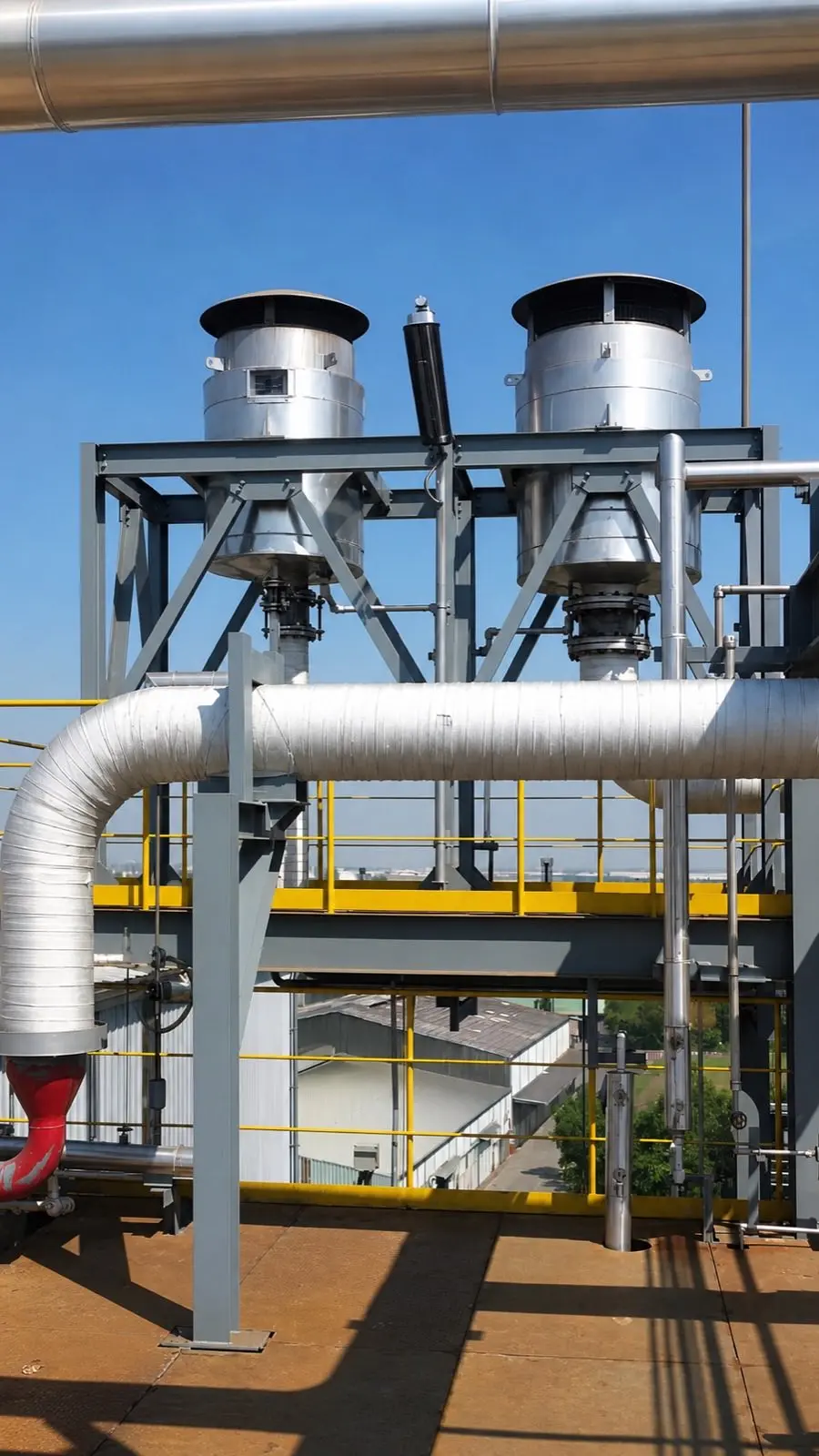
Diffuser silencers (also called vent silencers or blow-down silencers) are specialized devices designed for high-pressure gas discharge to atmosphere. They work by splitting the high-velocity single jet into many small jets through a multi-hole diffuser plate, reducing the acoustic power per jet and shifting the noise spectrum to higher frequencies that are more easily absorbed.
Performance characteristics: Very high attenuation (25-45 dB(A)) for high-pressure atmospheric discharges. Performance depends on the pressure ratio, diffuser hole diameter, total open area, and any absorptive treatment downstream of the diffuser.
Best suited for: Safety valve discharges, steam vents, blow-down systems, start-up vents, and any application involving high-pressure gas discharge to atmosphere.
Limitations: Only applicable to atmospheric discharge applications. Cannot be used for inline (ducted) applications.
Exhaust Silencers
Exhaust silencers are specifically designed for internal combustion engines (diesel generators, gas engines, gas turbines) and combine reactive and absorptive elements tuned to the exhaust frequency content. They are typically categorized by performance grade:
- Residential grade: 15-20 dB(A) insertion loss
- Industrial/critical grade: 20-25 dB(A) insertion loss
- Hospital/super-critical grade: 25-35 dB(A) insertion loss
Key Selection Criteria
Proper industrial silencer selection requires specification of several critical parameters:
1. Medium (Gas Composition)
The gas composition determines material requirements, corrosion concerns, and acoustic properties (speed of sound, density). Common media include:
- Clean air (HVAC, compressor intakes)
- Combustion exhaust (engines, boilers, furnaces)
- Steam (vents, safety valves, blow-down)
- Process gas (hydrocarbons, hydrogen, nitrogen, corrosive gases)
For corrosive or high-temperature gases, material selection (stainless steel, Inconel, Hastelloy) significantly impacts cost and lead time.
2. Pressure and Temperature
Operating pressure determines the silencer's structural design requirements (wall thickness, flange ratings, code compliance). Operating temperature determines material selection, expansion provisions, and whether absorptive materials can be used (standard mineral wool is limited to approximately 650°C; higher temperatures require ceramic fiber or metallic absorptive media).
3. Flow Rate
The gas flow rate, combined with the silencer cross-sectional area, determines the face velocity through the silencer. Excessive face velocity generates self-noise (noise created by the flow through the silencer itself) that limits the achievable attenuation. Design face velocities are typically:
- Absorptive silencers: 10-20 m/s
- Reactive silencers: 15-30 m/s
- Diffuser silencers: 50-100 m/s at the diffuser plate (with expansion to lower velocity downstream)
4. Target Noise Reduction
The required insertion loss (IL), specified in dB by octave band from 63 Hz to 8000 Hz, is the fundamental performance parameter. Overall dB(A) reduction alone is insufficient — octave-band requirements ensure the silencer design addresses the correct frequency range. Common targets include:
- Vent silencers: 25-40 dB(A) overall
- Engine exhaust silencers: 15-35 dB(A) depending on grade
- HVAC duct silencers: 10-25 dB(A) depending on duct velocity and run length
- Compressor intake/discharge silencers: 15-30 dB(A)
5. Allowable Pressure Drop
Pressure drop through the silencer affects system performance and operating cost. The silencer must be designed to achieve the target insertion loss within the allowable pressure drop constraint. Typical pressure drop limits:
- Fan systems: 100-300 Pa (excessive pressure drop reduces fan capacity and increases energy consumption)
- Compressor intakes: 500-2000 Pa (excessive drop reduces compressor efficiency)
- Engine exhausts: 2-5 kPa (excessive back-pressure reduces engine power and increases fuel consumption)
- Safety valve vents: minimal (back-pressure must not affect valve certified capacity)
6. Space Constraints
Silencer dimensions (length, diameter, weight) must fit the available installation space. Absorptive silencers can be made shorter by increasing the cross-sectional area (more parallel sound-absorbing channels), but this increases diameter and weight. Reactive silencers have dimensions dictated by the target frequency — low frequencies require physically large chambers.
Application Matching Guide
| Application | Primary Noise Type | Recommended Silencer Type | Typical IL dB(A) | |---|---|---|---| | Fan inlet/outlet | Broadband + blade tone | Absorptive or combination | 15-25 | | Compressor intake | Broadband + pulsation | Combination | 15-30 | | Reciprocating engine exhaust | Tonal + broadband | Reactive + absorptive (combination) | 20-35 | | Gas turbine exhaust | Broadband (high temp) | Absorptive (high-temp materials) | 20-30 | | Safety valve discharge | Jet noise (broadband) | Diffuser + absorptive | 25-40 | | Steam vent | Jet noise (broadband) | Diffuser + absorptive | 30-45 | | Pneumatic exhaust | Jet noise (high frequency) | Diffuser | 20-30 | | HVAC duct | Broadband | Absorptive | 10-20 | | Boiler stack | Combustion rumble + broadband | Combination | 15-25 |
Common Specification Mistakes
Specifying only overall dB(A): Without octave-band performance requirements, a silencer may achieve the overall dB(A) target but leave a prominent tonal frequency inadequately treated.
Ignoring self-generated noise: At high flow velocities, the silencer itself generates noise that sets a floor on achievable attenuation. This self-noise limit must be considered during silencer design.
Overlooking temperature effects: Absorptive material degradation at high temperatures reduces performance over time. Specify the actual operating temperature, not the design pressure/temperature of the piping system.
Underspecifying structural requirements: Silencers in cyclic service (safety valves, intermittent vents) experience severe thermal shock and dynamic loading. Structural design must account for these conditions.
Conclusion
Selecting the right industrial silencer requires a systematic approach that considers the noise source characteristics, the medium, the operating conditions, the required attenuation, and the physical constraints. There is no universal silencer — each application demands a design optimized for its specific requirements.
ARK Noise Control designs and manufactures all types of industrial silencers, from HVAC duct silencers to high-pressure steam vent silencers. Our silencer designs are based on proven acoustic models, validated by extensive field measurement data, and backed by performance guarantees. Contact our engineering team to discuss your silencer selection requirements.