Steam vent noise is among the most intense and disturbing noise sources in industrial environments. When high-pressure steam is discharged to the atmosphere through safety valves, blow-down systems, start-up vents, or deaerator exhausts, the resulting noise can reach levels of 120 to 140 dB(A) at close range — far exceeding the threshold of pain and capable of causing instantaneous hearing damage. Beyond the occupational hazard, steam vent noise is one of the most common causes of community noise complaints from power plants, refineries, and chemical processing facilities. This article examines the physics behind steam vent noise, proper measurement methodology, and the engineering solutions available to control it.
The Physics of Steam Vent Noise
Understanding why steam vents are so extraordinarily loud requires an understanding of aeroacoustics — the science of noise generated by fluid flow.
Sonic Jet Noise
When steam is discharged through a valve or nozzle with a pressure ratio greater than approximately 1.9:1 (upstream absolute pressure to downstream atmospheric pressure), the flow at the valve throat reaches sonic velocity (Mach 1). For saturated steam at typical industrial pressures (5 to 100 bar gauge), this critical pressure ratio is always exceeded during atmospheric discharge, meaning the discharge jet is always sonic or supersonic.
A sonic or supersonic free jet generates noise through several mechanisms:
- Turbulent mixing noise: The high-velocity steam jet mixes with the surrounding still air, creating intense turbulent shear layers that generate broadband noise. The acoustic power of a subsonic jet is proportional to the eighth power of jet velocity (Lighthill's law), while supersonic jets produce even more noise due to shock-associated mechanisms
- Shock-associated noise: Supersonic jets contain a pattern of standing shock waves (Mach diamonds) that generate intense broadband noise and discrete screech tones when the jet is imperfectly expanded
- Shock noise: Interaction between turbulent eddies and the shock cell structure generates broadband shock-associated noise (BBSN) that peaks at frequencies above the peak mixing noise frequency
The combination of these mechanisms produces the extraordinarily high sound power levels characteristic of steam vent noise. A safety valve discharging steam at 40 bar gauge through a 150 mm orifice can generate a sound power level of 155 to 165 dB — equivalent to a jet engine at takeoff.
Frequency Characteristics
Steam vent noise is predominantly high-frequency, with the peak frequency determined by the jet diameter and exit velocity. For typical industrial steam vents, the peak frequency falls in the 1000 to 4000 Hz range — coinciding with the frequency range of maximum human hearing sensitivity, which is why steam vent noise is perceived as particularly loud and disturbing relative to its measured dB(A) level.
Blow-Down Noise Characteristics
Blow-down noise during boiler blow-down operations shares the same physics as steam vent noise but involves a two-phase mixture of steam and water. The presence of water droplets in the discharge modifies the noise spectrum somewhat (additional broadband content from droplet breakup) and creates additional concerns regarding condensate fallout and corrosion of noise control equipment.
Typical Steam Vent Noise Levels
The following table provides representative noise levels for common steam discharge scenarios. These levels are at 1 meter from the discharge point unless otherwise noted:
| Source | Typical Pressure | Typical dB(A) at 1m | |---|---|---| | Main steam safety valve | 60-120 bar | 130-145 dB(A) | | Boiler drum safety valve | 40-100 bar | 125-140 dB(A) | | HP/IP bypass valve discharge | 30-80 bar | 120-135 dB(A) | | Blow-down valve discharge | 10-100 bar | 115-135 dB(A) | | Deaerator vent | 1-3 bar | 100-115 dB(A) | | LP steam vent | 2-10 bar | 105-120 dB(A) | | Start-up vent (turbine bypass) | 20-100 bar | 125-140 dB(A) |
These levels attenuate with distance according to the inverse square law (approximately 6 dB per doubling of distance in free field), but even at 100 meters, a high-pressure safety valve discharge can produce levels exceeding 100 dB(A).
Measurement Methodology
Measuring steam vent noise presents unique challenges due to the extreme levels involved and the intermittent, unpredictable nature of safety valve discharges.
Equipment Requirements
Standard Type 1 or Type 2 sound level meters have an upper measurement limit of 140 dB, which can be exceeded by high-pressure steam vents. For measurements within 10 meters of a high-pressure discharge, specialized high-level microphones or microphone-extension cables with remote preamplifiers may be needed.
Measurement Protocol
For safety valve noise assessment, the recommended approach includes:
1. Far-field measurements: Measure at multiple distances from the vent discharge (typically 30, 50, 100, and 200 meters) in multiple directions. Use these measurements to calculate the sound power level of the source using ISO 3746 hemispherical method 2. Receiver locations: Measure at the plant boundary and at the nearest noise-sensitive receivers to establish the impact level 3. Frequency analysis: Obtain octave-band measurements (minimum 63 Hz to 8000 Hz) for silencer design. One-third octave-band data is preferred for more precise design work 4. Duration: For intermittent vents (safety valves, blow-down), measure during actual discharge events. For continuous vents (deaerator, LP steam), standard steady-state measurement procedures apply 5. Background: Measure background noise with the vent inactive for comparison and to ensure adequate signal-to-noise ratio
Prediction Methods
When measurement during actual discharge is not practical (e.g., for a new plant in the design phase), steam vent noise can be predicted using semi-empirical methods. The most widely used prediction standard is the method described by the Valve Manufacturers Association (VMA) and adapted in IEC 60534-8-3, which predicts noise based on mass flow rate, upstream pressure, downstream pressure, valve Cv, and discharge pipe geometry.
Steam Vent Silencer Designs
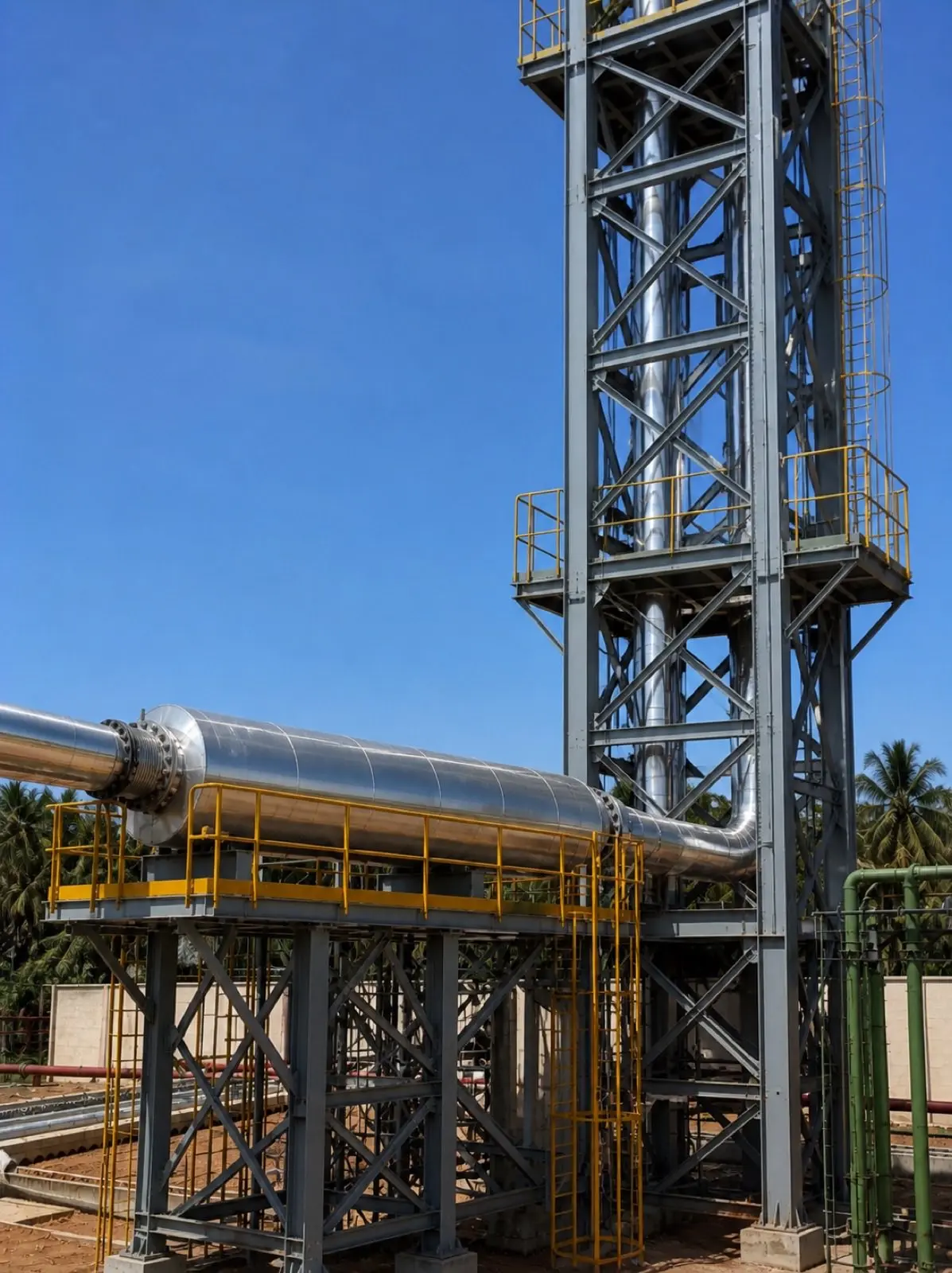
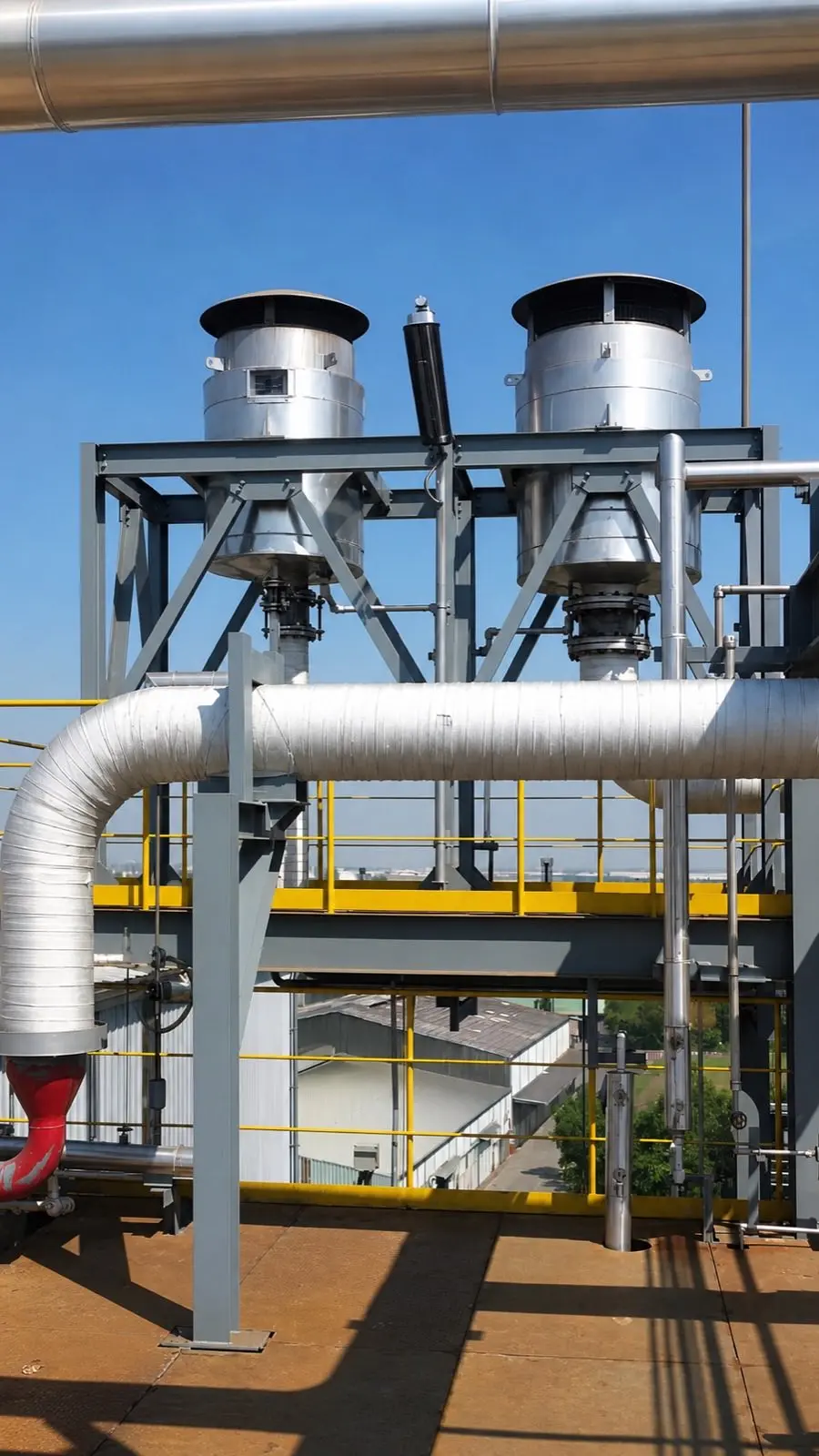
A steam vent silencer (also called a safety valve silencer or blow-down silencer) is a device installed on the vent pipe downstream of the safety valve or blow-down valve to reduce discharge noise while allowing free passage of the steam to the atmosphere. Several design approaches are used:
Diffuser-Type Silencers
Diffuser silencers work by dividing the single high-velocity jet into many smaller jets through a multi-hole diffuser plate or a series of concentric perforated cylinders. The smaller jets have lower individual acoustic power (proportional to the fifth power of jet diameter for a given total flow) and higher peak frequencies that are more readily absorbed by the atmosphere and any absorptive elements in the silencer.
A well-designed diffuser silencer can achieve 25 to 35 dB(A) of noise reduction with minimal back-pressure, making it the preferred choice for safety valve applications where any back-pressure increase could affect the valve's certified flow capacity. Design parameters include hole diameter (typically 6-12 mm), total open area (must exceed valve outlet area), and diffuser geometry.
Absorption-Type Silencers
Absorption silencers use acoustic-grade absorptive material (mineral wool or glass wool, protected by perforated metal and a wire mesh scrim) to absorb sound energy as the steam passes through the silencer body. Absorption silencers are effective for continuous or long-duration vents where the flow is relatively steady.
For high-pressure steam applications, the absorptive material must be protected from moisture damage and erosion. Stainless steel perforated metal, Inconel wire mesh, and hydrophobic-treated mineral wool are commonly specified.
Combination Silencers
The highest-performance high-pressure steam silencers combine diffuser and absorption elements. The steam first passes through a diffuser section that reduces the jet velocity and re-distributes the flow, then passes through an absorptive section that attenuates the remaining broadband noise. Combination silencers can achieve 35 to 45 dB(A) of noise reduction and are the standard solution for high-pressure safety valves in power plants and refineries.
Design Considerations
All steam vent silencer designs must address:
- Back-pressure: For safety valve applications, the silencer must not increase the back-pressure beyond the valve manufacturer's allowable limit (typically 10% of set pressure for conventional valves). This is a non-negotiable safety requirement
- Structural integrity: The silencer must withstand the dynamic forces, thermal shock, and vibration associated with sudden high-pressure discharge. Safety valve discharges involve near-instantaneous loading from zero flow to full rated flow
- Materials: Stainless steel construction is standard for steam service. High-temperature steam (above 400°C) may require Inconel or other high-temperature alloys
- Drainage: The silencer must be designed to drain condensate freely and not accumulate water that could freeze in cold climates or cause corrosion
- Maintenance: While silencers have no moving parts, the absorptive elements may require periodic inspection and replacement, particularly in dirty service or where condensate carryover occurs
Case Example: Power Plant Safety Valve Silencing
A 500 MW thermal power plant experienced community noise complaints during safety valve lifting events. Measurements showed that the main steam safety valves (3 valves, 100 bar set pressure, 200 mm orifice) produced noise levels of 138 dB(A) at 1 meter, resulting in 85 dB(A) at the plant boundary 400 meters away — well above the CPCB nighttime limit of 70 dB(A) for industrial areas.
ARK Noise Control designed and supplied combination diffuser-absorption silencers for all three safety valves. The silencers achieved 38 dB(A) noise reduction, bringing the plant boundary level during safety valve events to 47 dB(A) — comfortably below the nighttime limit. The silencers were designed with zero additional back-pressure impact on the valve certified capacity.
Conclusion
Steam vent noise is a serious occupational and environmental concern that is entirely solvable with proper engineering. Modern steam vent silencer designs can reduce discharge noise by 25 to 45 dB(A) without compromising safety valve performance or adding significant back-pressure. The key to success is proper characterization of the noise source (pressure, flow rate, temperature, valve type), selection of the appropriate silencer design, and rigorous structural and acoustic engineering.
ARK Noise Control has designed and supplied hundreds of steam vent silencers, safety valve silencers, and blow-down silencers for power plants, refineries, and chemical facilities across India. Our silencer designs are backed by performance guarantees and are proven in some of the most demanding steam discharge applications in Indian industry.