Industrial noise control involves a specialized vocabulary of acoustic ratings and metrics that can be confusing for engineers, plant managers, and procurement professionals who are not acoustics specialists. Three ratings appear most frequently in noise control specifications, product data sheets, and vendor proposals: STC (Sound Transmission Class), NRC (Noise Reduction Coefficient), and dB(A) (A-weighted decibels). Understanding what each rating measures, how it is determined, and when it applies is essential for evaluating noise control solutions and making informed decisions.
The Decibel Scale: Foundation of All Acoustic Measurement
Before discussing STC and NRC, it is important to understand the decibel (dB) — the fundamental unit of sound measurement.
What is a Decibel?
The decibel is a logarithmic ratio that expresses the intensity of sound relative to a reference level. The reference level for sound pressure is 20 micropascals (20 μPa), which represents the threshold of human hearing — the quietest sound a healthy young person can detect.
The logarithmic scale is used because the human ear perceives sound intensity on a roughly logarithmic basis, and because the range of sound pressures encountered in practice is enormous — from the threshold of hearing (20 μPa) to the threshold of pain (200 Pa), a ratio of 10 million to one. The decibel scale compresses this vast range into a manageable scale of 0 to 140 dB.
Key properties of the decibel scale that are essential for understanding noise control:
- Doubling the sound energy increases the level by 3 dB — this is why the EU and ACGIH use a 3 dB exchange rate for occupational exposure
- A 10 dB increase is perceived as approximately twice as loud — this means that a 100 dB source sounds about twice as loud as a 90 dB source to a human listener
- Combining two equal sources adds 3 dB — two identical 90 dB machines running together produce 93 dB, not 180 dB
- A source that is 10+ dB below the total is negligible — if one machine produces 90 dB and another produces 78 dB, the combined level is still approximately 90 dB. This principle guides prioritization in noise control: treat the dominant sources first
A-Weighting: The dB(A) Scale
The human ear does not perceive all frequencies equally. We are most sensitive to mid-frequencies (1000-4000 Hz) and relatively insensitive to low frequencies (below 200 Hz) and very high frequencies (above 10,000 Hz). The A-weighting filter is a standardized frequency-weighting curve that approximates human hearing sensitivity by reducing the contribution of low and high frequencies to the measured level.
A-weighted measurements are denoted as dB(A) and are the standard metric for:
- Occupational noise exposure assessment (OSHA, ACGIH, EU Directive)
- Environmental noise limits (CPCB, EPA guidelines)
- Equipment noise specifications
- Noise control performance claims
A decibel chart of typical A-weighted noise levels provides useful context:
| Source | Typical dB(A) | |---|---| | Threshold of hearing | 0 | | Quiet library | 30 | | Normal conversation (1m) | 60 | | Busy office | 65-70 | | Factory floor (typical) | 80-95 | | Reciprocating compressor (1m) | 95-110 | | Gas turbine intake (1m) | 110-125 | | Safety valve discharge (1m) | 125-140 | | Threshold of pain | 130-140 |
Other weighting filters exist: C-weighting (dB(C)) gives more weight to low frequencies and is used for peak measurements and low-frequency noise assessment; Z-weighting (dB(Z)) is unweighted and represents the actual physical sound pressure level.
Sound Transmission Class (STC)
What STC Measures
Sound Transmission Class (STC) is a single-number rating that describes how well a building element (wall, floor, ceiling, door, window, or panel) blocks sound from passing through it. A higher STC rating means better sound blocking — more of the sound energy is reflected or absorbed by the element, and less is transmitted through to the other side.
STC is determined by measuring the Transmission Loss (TL) of the element at 16 standard test frequencies from 125 Hz to 4000 Hz in a laboratory setting according to ASTM E90 (measurement procedure) and ASTM E413 (classification procedure). The measured TL values are compared against a standard STC contour, and the STC rating is the value at which the contour provides the best fit to the measured data.
How STC is Measured
STC testing requires two adjacent reverberation chambers separated by the test specimen. A noise source in one chamber produces a known sound field; sound level meters in both chambers measure the levels on each side of the test specimen. The difference, corrected for the specimen area and the receiving room absorption, gives the Transmission Loss at each frequency.
Typical STC Values for Industrial Materials
| Material / Construction | Typical STC Rating | |---|---| | Single layer 1.2mm steel sheet | STC 25-28 | | Single layer 2.0mm steel sheet | STC 28-32 | | 50mm acoustic panel (steel-mineral wool-perf steel) | STC 30-35 | | 100mm acoustic panel (steel-mineral wool-perf steel) | STC 35-42 | | 150mm high-performance acoustic panel | STC 42-50 | | Concrete block wall (200mm) | STC 45-50 | | Double-wall acoustic panel with air gap | STC 45-55 | | Acoustic enclosure panel (ARK Multi-Reflective) | STC 40-52 |
When STC Applies
STC is the appropriate rating when you need to know how much sound a panel or wall will block — specifically:
- Specifying acoustic enclosure panel performance
- Evaluating building wall and roof constructions for noise containment
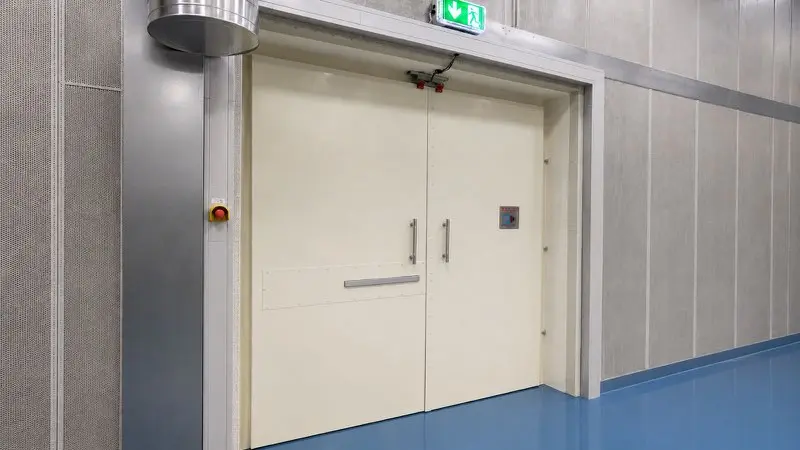
- Comparing door and window acoustic performance
- Designing noise barriers (single-number rating for the barrier panel)
Important limitation: STC is weighted toward mid and high frequencies (500-4000 Hz). For noise problems with strong low-frequency content (below 200 Hz), STC may overestimate the perceived sound blocking effectiveness. In such cases, request octave-band TL data in addition to the STC rating.
Noise Reduction Coefficient (NRC)
What NRC Measures
The Noise Reduction Coefficient (NRC) is a single-number rating that describes how much sound a surface absorbs rather than reflects. An NRC of 0.00 means the surface reflects all sound (like a smooth concrete wall), while an NRC of 1.00 means the surface absorbs all sound that hits it. In practice, most acoustic absorbers have NRC values between 0.50 and 0.95.
NRC is calculated as the arithmetic average of the sound absorption coefficients measured at four standard frequencies: 250 Hz, 500 Hz, 1000 Hz, and 2000 Hz. Absorption coefficients are measured in a reverberation chamber according to ASTM C423.
How NRC is Measured
The absorption coefficient is measured by placing a sample of the material in a reverberation chamber and measuring the change in reverberation time (the time for sound to decay by 60 dB after the source is turned off). More absorption reduces the reverberation time, and the absorption coefficient is calculated from the measured change.
Typical NRC Values for Industrial Materials
| Material | Typical NRC | |---|---| | Smooth painted concrete | 0.05 | | Metal sheet (unperforated) | 0.05-0.10 | | Plywood panel | 0.10-0.15 | | Standard carpet | 0.30-0.40 | | 50mm mineral wool (48 kg/m³) | 0.75-0.85 | | 100mm mineral wool (48 kg/m³) | 0.90-0.95 | | 50mm mineral wool (96 kg/m³) | 0.80-0.90 | | 100mm mineral wool (96 kg/m³) | 0.95-1.00 | | ARK Multi-Absorptive acoustic panel (interior face) | 0.90-0.95 | | Perforated metal (25% open) + 50mm mineral wool | 0.70-0.85 | | Perforated metal (25% open) + 100mm mineral wool | 0.85-0.95 |
When NRC Applies
NRC is the appropriate rating when you need to know how much sound a surface will absorb — specifically:
- Selecting absorptive lining for the interior of acoustic enclosures
- Designing room acoustics to reduce reverberation and reflected noise
- Evaluating absorptive silencer fill materials
- Specifying absorptive treatments for walls and ceilings in noisy production areas
Important limitation: NRC averages absorption at 250-2000 Hz only. For low-frequency noise (below 250 Hz), the NRC value may significantly overstate the actual absorption. For industrial noise control, always request octave-band absorption coefficients (at least 125 Hz to 4000 Hz) in addition to NRC.
How the Three Ratings Work Together
In a typical industrial noise control project, all three ratings come into play:
1. dB(A) is used to measure the noise problem (how loud is the source?) and to specify the noise target (what level must be achieved at the receiver?)
2. STC is used to specify the sound blocking performance of enclosure panels, barriers, and building elements — ensuring they have sufficient transmission loss to block the noise from passing through
3. NRC is used to specify the sound absorption performance of interior linings — ensuring that sound inside an enclosure or noisy room is absorbed rather than building up through reflections
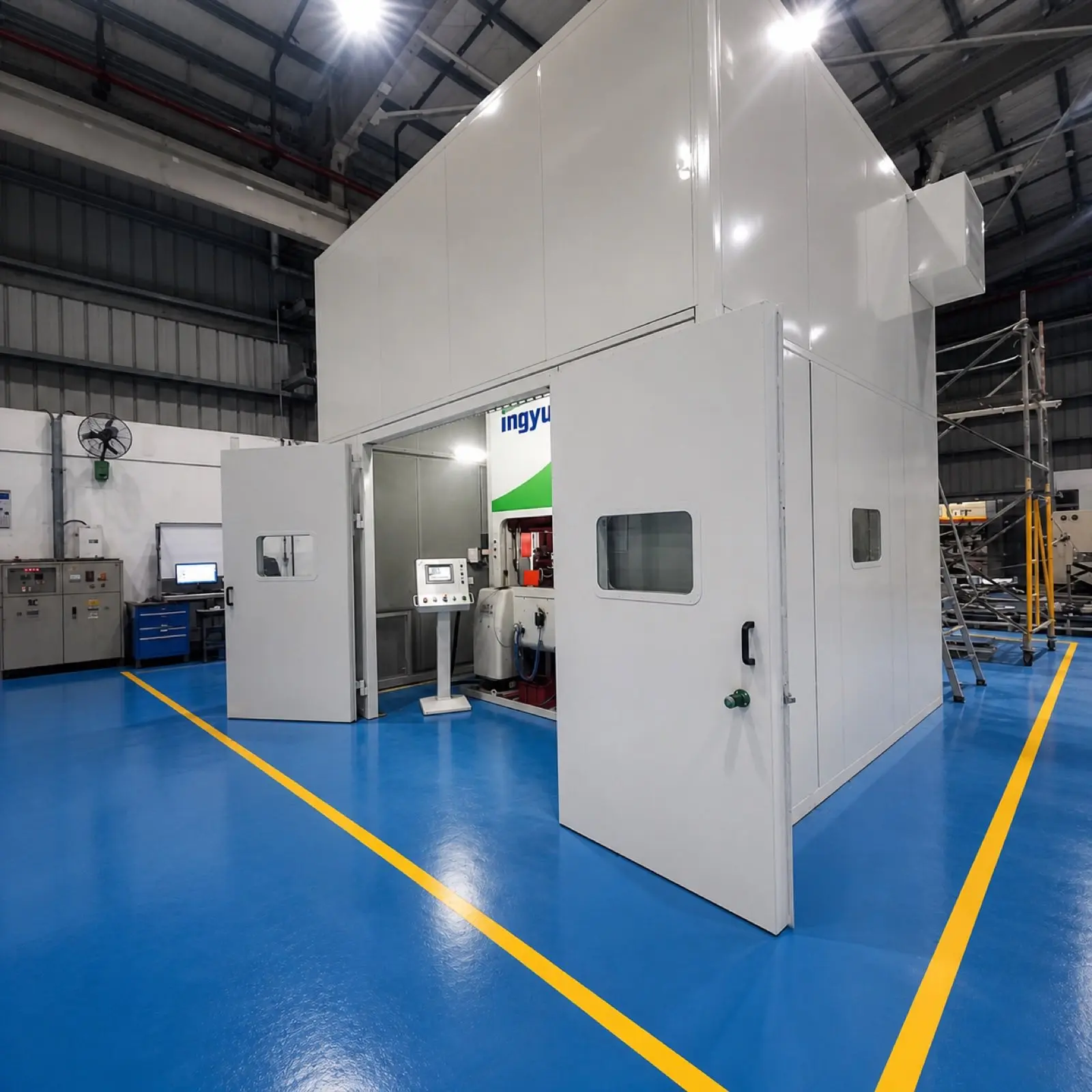
A well-designed acoustic enclosure, for example, combines high-STC panels (to block sound transmission through the walls) with high-NRC interior linings (to absorb sound within the enclosure and prevent reverberant build-up). The combined effect delivers the overall noise reduction measured in dB(A) at the receiver location.
Common Misconceptions
"Higher STC means better noise control": STC measures sound blocking only. A panel with STC 50 blocks sound well but does not absorb it — sound will reflect off its surface. For the interior of an enclosure, NRC matters more than STC.
"NRC 0.90 is 90% noise reduction": NRC 0.90 means 90% of sound energy hitting the surface is absorbed — but this does not translate directly to a 90% reduction in noise level. The relationship between absorption and noise reduction depends on the room geometry, the total absorptive area, and the source-receiver distance.
"dB(A) reduction is the same as STC": The overall noise reduction of a noise control treatment (measured in dB(A)) depends on many factors beyond the panel STC — including flanking paths, ventilation openings, seal quality, and the frequency content of the noise source.
Conclusion
STC, NRC, and dB(A) are complementary metrics that together describe the performance of industrial noise control systems. Understanding what each measures — and what each does not measure — is essential for writing accurate specifications, evaluating vendor proposals, and making informed procurement decisions.
At ARK Noise Control, we provide full acoustic data for all our products — not just single-number ratings, but octave-band transmission loss, octave-band absorption coefficients, and verified overall dB(A) performance. Our engineering team is always available to help you interpret acoustic data and select the optimal solution for your noise control requirements.